Knowledge forbidden?
Milton
Suspicious, reasonless. Why should their Lord
Envy them that? Can it be a sin to know?
Can it be death?
As a whole, humans are still operating inside of our own species, telling stories about human conquests over nature and over each other. This is the stuff of history: what territory was taken, which dynasties usurp other dynasties, what great things have been invented, who dominates whom to optimize and define a specific period or era.
Even though we like to think of ourselves as special, only nominally of the same substance as other creatures, our infatuation with battles, achievements, triumphs, and political intrigue is evidence enough that we are still just sitting inside our ape brains, keeping score on which of us is the sexiest, the strongest, the best, the worst, the most worthy of attention. This is the raw material of all social primates, a class of animals evolved to keep meticulous track of… each other.
In the broadest sense, our being trapped inside our species stories is a sign that we haven’t yet come to grips with our power as a single human force. As yet, we have not come to grips with the disturbing notion that this power is not unquestionably good, and indeed may not actually be good at all. So our stories accrete and gods emerge to explain the victories and the defeats. We become obsessed with these godly totems: religion, nationalism, historical progress, economic growth, and the expansive individual.
As such, the story of civilization is really the story of a mega-potent primate winding out the reckless cords of its own power, largely oblivious to the profoundly unnatural effects of that force. It is becoming increasingly evident that we have to leave much of this civilizational framework behind if we want to have any hope of escaping the bonds of our own destructive power. But how can we do that? How do we step outside the confines of our own civilizational power, both physically and conceptually?
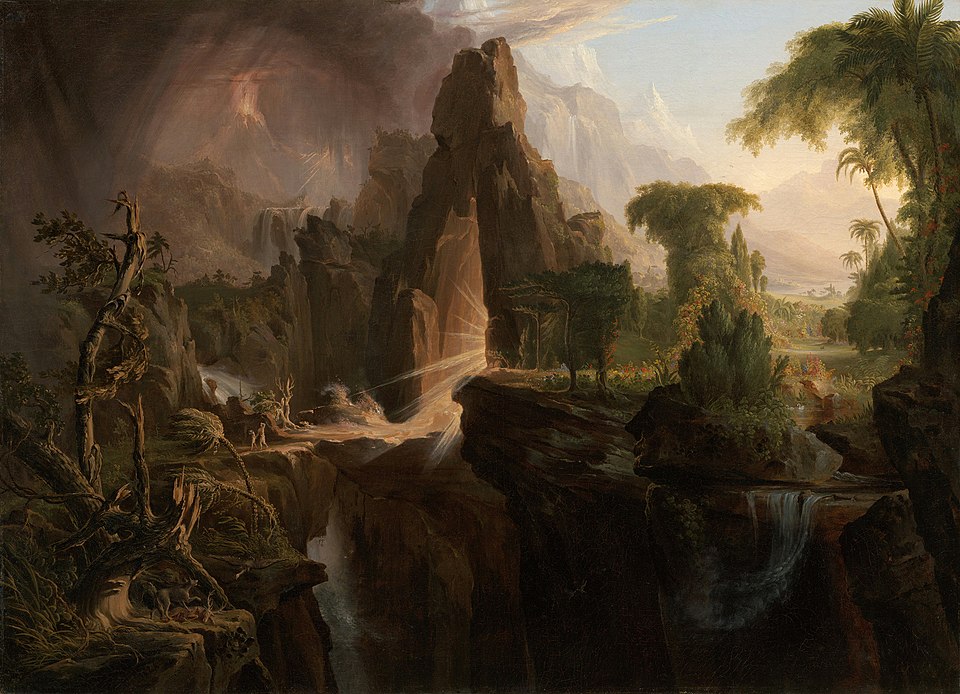
Let’s start with the Garden of Eden story, the tale that kicked off Western Civilization itself, and sent us off on the road of history. On its face, in its Judeo-Christian format, the Eden story is about the goodness of creation, the generosity of God in providing an idyllic home for his beloved humans, the disobedience of those chosen creatures, and God’s subsequent anger, which resulted in expulsion from the garden and the eternal curses of birthing pain, harsh landscapes, and eternally onerous toil.
But let’s recall some unusual details. It’s very odd that God would create a specific tree, stick it in the middle of the garden, and then tell Adam and Eve, “don’t touch!” Why would an omnipotent God, who perhaps created people to have company for himself, make a forbidden tree and shove it in their mugs to look at and be tempted by, every day? It makes no sense. How about, if you’re God… just don’t create that tree in the first place, and there’s no problem? Then you can hang out with your prize creation forever. Toss the frisbee, picnics, the whole deal.
Most theological glosses on the Eden story don’t hold up. “Oh, God gave us free will, and the forbidden fruit was created to test that freedom.” Would Adam and Eve choose obedience to God, or would they succumb to their own pride, etc.? Well, to use an obscure theological term, that’s just stupid. This is merely and example of an ancient myth that was preserved through centuries of oral tradition for its “stickiness,” in the meme sense, but then later came to need a rationalization to be included in a more serious literary canon, because it didn’t age well in a purely philosophical sense.
And that is not even mentioning the millennia of misogyny that the Eden story has spawned, blaming women for sin and death, using the barbaric doctrine of Original Sin to lay the groundwork for the entire Christ-as-Redeemer essence of Pauline Christianity, a conceptual atrocity laid on top of an archaic myth.
But leaving this all aside for a moment, let’s remember what that forbidden fruit actually was. It came from the Tree of the Knowledge of Good and Evil. But what the hell is that? The whole universe had just been created. Why would there suddenly be a tree whose fruit unveils the nature of good and evil? What even is that? And also, what was evil at that point? It couldn’t have been the disobedience of Adam and Even itself, as the tree pre-dates their “sin.” So where did this evil come from, and what even was it?
At this point, we’ve now come to the crucial need to recognize myth as a completely different thing than theology or philosophy. The Eden story is pure myth, having nothing to do with history, reality, or even theological explanation in the strict sense. So as myth, what the hell was that Tree of the Knowledge of Good and Evil all about? What did it represent, considering that it makes no sense as an explanation for anything real?
For my part, I am convinced by the ideas of Daniel Quinn, the author of Ishmael and other amazing books about human history, human nature, and an alternative way of living that embraces our creature-ness. In Quinn’s reading, the Tree of the Knowledge of Good and Evil was a symbol for humanity grabbing up the mantle of nature’s primary driving question: “What lives and what dies?” In eating that forbidden fruit, humanity abandoned the rulership of God over the cosmos, and assumed for itself the role of decision makers on who and what survives or perishes.
In other words, when Adam and Eve ate the fruit, they were exercising their full power over the earth, which is a shoddy dominion when compared with God’s divine judgment and wisdom. In that sense, the Eden myth takes on an obviously ecological tinge. At the dawn of the major Axial Age civilizations (800-200 BCE), there was still a remembrance of, even if only shadowy, a more idyllic, tribal existence, a more balanced and easy lifestyle that was shattered by the emergence of great empires and civilizations.
The Eden story, then, is ultimately about power, the harsh consequences of a species that had abandoned the more “natural” tribal way of life, which had developed over millions of years of primate evolution, in favor of an aggressive, dominating lifestyle that viewed nature, other creatures, and even other human beings, as a blank canvas for the exercise of power over life and death. The true “sin” here is not disobedience, and not even hubris, unless that hubris is referenced explicitly against the natural world. [Hubris as a classical sin really makes no sense unless there is referent, and that referent must be a natural one, to make sense in this Eden story.]
In this light, we can see that Christianity, and all other major world religions birthed in the Axial Age, are ecological theodicies, the crying out of emerging civilizations over how and why things had gone so wrong. The Eden story is a mythological exploration of how the idyllic tribal life was lost, replaced by brutal, stark, hierarchical empires of conquest, slavery, famine, domination, suffering, and ecological collapse. Religions explain this loss of paradise as tragic but ultimately necessary, in order to lay the groundwork for the redemptive work of spiritual heroes, adepts, and saviors. The ecological catastrophe that is human power itself is thus disappeared, and the possibility of true earthly wholeness is shunted away into worldly riches for the priest-warrior classes and postponed redemption for everyone else, to be fulfilled only beyond the grave or in a future bodily incarnation.
The entire history of Western civilization has been a long (although vanishingly short in evolutionary time) extension of this failure to understand the true meaning of the Eden story. Our problem is not sin, or evil, or disobedience, or the tragic frailty of free will. These are all just stories told from inside the primate brain: Who is good? Who is bad? How can the good triumph over the bad? How can we atone for our badness? What superhuman person or entity can we pledge fealty to, to defeat death?
Instead, we should see the Eden story as the most ecologically relevant story in the Western tradition. Rip out the priestly, theological glosses, and we’re left with the conundrum that is still the basic for humanity today: Can we resist the seduction of our own power? Can we give up the ability to decide who lives and who dies, what thrives and what perishes? Can we return that power to nature instead? If not, then the Eden story tells us what we’re in for: endless pain, struggle, suffering, and death. But crucially, ecologically, there is no heaven waiting beyond that destruction.
We’ve waded into deep waters here. I myself am not a religious person, not a “believer.” But I do have a fundamentally religious mind. I was raised in religion, first Catholicism and later Protestantism, and I studied religion in college and grad school. I have always been around religious people and all kinds of religious texts. As a result, I still see the main issues for humanity through a “religious” lens, and the biggest challenge for us as a species is, for lack of a better word, a spiritual one.
But unlike religious stories, we don’t know the ending to our post-Eden ecological saga. The jury is still out, and evidence is mounting that our ultimate fate as a species could be… failure. This is not to say that human beings will be completely eradicated, leaving the earth to bugs and fungi. Human beings will likely persist, no matter how much damage we do to our home. But the questions will then be: How many of us will be left? And, what kind of life is possible on a scorched and mortally-wounded planet?
To solve our ecological dilemma, we have to think both bigger and smaller at the same time. Now, this is not exactly the same as that old saw, “Think global, act local.” But it’s in that ballpark. What is required is something very hard at the macro-level, but really pretty easy at the micro-level. Fortunately, the latter is the route to the former.
At the “global” level, for lack of a better word, we have to get outside of our tribal, primate brains, and start seeing ourselves as an entire species, a piece of nature like so many other living and non-living entities. We’re not magical fairies sprinkling enchanted sparkles around the hedges and heaths. We’re an individually-meek but collectively-powerful animal, made of the same bone, muscle, and neuron as any other terrestrial creature.
We need to see our presence on the planet not as Americans, Chinese, or Russians, engaged in parochial struggles over who gets to define and dominate some fleeting, arbitrary era. Rather, we have to recast our story as one of a massively powerful single species, one that is wiping out the rest of the natural world in a rapid, reckless, cancerous expansion. While we cling to our totems and myths, projecting heroism, glory, and salvation onto an anthropomorphized cosmos, the reality is much more blunt: we are spewing out destruction on a grand scale, everywhere deciding what lives and what dies, the original “sin” of Eden.
Obviously, getting billions of people to embrace that macro-story of humanity is a non-starter. Our tribal primate stories are too entrenched, and the Other is still seen as a threat, even though we are all of the same genetic stuff. The key here, strangely, is economic. The main reason that we’re still so embedded in our tribal, nationalistic rivalries is that, as the technics of power have evolved, more and more societies are highly unequal, with severe precarity for the masses coexisting with the exploding riches and gaudy luxuries for the plutocrats.
This divergence of fortunes renders our societies in capable of creating any real alternatives to the status quo, and governance devolves into plutocrats crafting tribal blame stories to stall for time while economic bounty continues to pile up at the top. We can hardly start thinking of ourselves as a unified species when we’re too busy targeting and hating immigrants, Jews, Arabs, gays, blacks, trans-people, Muslims, atheists, groomers, rednecks, and all other groups of people who aren’t…. us.
The only way to shatter this seemingly impenetrable defense of tribal thinking is from below. And it has to start somewhere. I think that somewhere is through Bigger Home Bases, supported by a Basic Income, and nationalized through an application of Modern Money Theory to our federal government spending.
See many earlier posts on this blog more more background on these three strategies.

