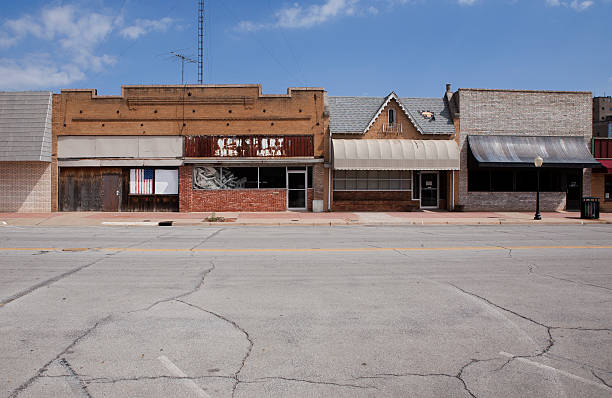
Under the pavement the dirt is dreaming of grass.
Wendell Berry
Our current crisis of place is pervasive yet largely unacknowledged. We see it everywhere, but we only talk about it tangentially, through the language of real estate or commuting time or the soullessness of strip malls. We live, or strive to live, in increasingly unaffordable yet somehow fragile micro-households (the US average household size is now between 2.53 and 3.15 people, depending on how you look at it). We inhabit or haunt our workplaces for an average of four years, changing jobs around 12 times during our “careers.” Even our churches have become over-specialized and disorienting. Religious institutions that used to cement communities are now full-fledged business concerns, dis-embedded mega-churches or over-politicized culture war enclaves, adding to the hyper-polarized battle of Red American vs. Blue American.
As our places become more fragile, expensive, and psychologically exhausting, we retreat into social media and the endless stream of content. But these virtual places are fleeting and vaporous, and no matter how hard we endeavor to make them satisfying, they slip through our fingers and memories.
To boot, all of our places, real and imaginary, have been enclosed and captured by moneyed interests. Consumer capitalism is a relentless, commodifying vampire, stalking the land for every opportunity to turn non-commercial activity and substance into products. Public places are increasingly less public (i.e., FREE), and our intermediate institutions, those things that supposedly hold republics together, are at higher price points, both monetarily and time-wise.
The Tocquevillian “Bowling Alone” critique gets us part of the way towards understanding what has become of our places and spaces, but the root of the crisis is the micro-household, which is the weaponized leading-edge of consumer industrial civilization. Despite the general sense that the American home is the bedrock of our society and our lives, people generally move around 12 times in their lives, and the average American homeowner only stays in their house for 12 years.
This endless uprooting of home, workplace, and the inner space of our psyches is tremendously disorienting. Product obsolescence and cultural churn have dislodged our sense of continuity, reliability, and stability. In a very real sense, nomadic hunter gatherers, the default condition of almost our entire tenure on earth, were in a more permanent situation than modern Americans today, where even our serial sedentariness, where we strive for a place of our own, cannot eliminate the overriding sense that the world is spinning out of control, that we’re all just one bad break away from financial and personal disaster.
Perhaps people have always said, “Yeah, things are crazy, right?” Maybe that old pseudo-Chinese curse is true: “May you live in interesting times.” But more likely, this ubiquity of discontent, this feeling that everything has gone off the rails, is actually a feature, and not a bug, of consumer capitalism itself, where every aspect of life and reality is absorbed into the maw of commerce and sold back to us for a fee.
In this strange situation of commodified unease, younger people are sold the idea that old people and their world are plodding, static dinosaurs, with an appropriate suite of paradigm-shattering and awesomely outrageous products offered to demonstrate their rebel-hood and distinctly non-dinosaur coolness. And then those old fogies, of which I guess I am now one, are peddled an alternate marketplace reality, where all this new stuff is crazy and offensive, and the rejection of that lunacy can be demonstrated through another set of stuff: the Hallmark Channel, Cracker Barrel, simple big-button phones, and food with real sugar and fat.
So we’re in a position where consumer-industrial capitalism is both shattering all of our safe places and spaces, including our inner minds, but then building on the resulting psychological and sociocultural chaos by selling us an endless stream of goodies to help us heal those wounds. The system is one huge arsonist-fireman construct, both destroying and healing, with a substantial surcharge slapped on each component along the way.
For regular people, people of all ages, this whipsawing of reality is completely at odds with a tribal social primate species that has evolved over millions of years to crave continuity and the permanence of interpersonal community, even if it is set within a nomadic physical lifestyle. Indeed, if there is no social continuity to offset that primal nomadism, then the result would be the intense sense of anxiety and stress which is the hallmark of our society today.
The human brain cannot well handle a continuous destruction of the real, even if it produces smaller phones and bigger TVs. The ongoing replacement of predictability with the endless churn of products and content has created a neurotic, schizophrenic public psyche, where people are forced to retreat to atavistic, unnatural, pseudo-tribes, the kind which emerged after early agricultural civilizations had wiped out the more integrated, actual tribes of hunter gatherers.
These atavistic tribes, which are deformed versions of the real thing, thrive within the destructive conditions of hierarchical civilizations, reconstituting a warped continuity based on race, ethic suspicion, and tightly-controlled religious identity. In our current state, many millennia removed from that original transition from tribe to mass society, these atavistic tribes, largely virtual now, are not just inadequate substitutes for real tribal permanence and continuity — they are actually damaging, as they shut off any possibility of envisioning a realistic response to the unsustainability of our entire civilizational system.
In other words, the ancient parochial is a poor vehicle of response to global ecological and economic collapse. An entirely different solution is needed, an alternate tribal formation that sheds the defects of obsolete atavistic versions.
Marx was a lousy soothsayer but a brilliant sociologist, and his historical materialism is, along with Darwin’s natural selection, one of the most powerful ideas anyone has ever had. If we truly want to recapture our sanity and our society, then we must build radically different physical places from the ground up — specifically, the household. Otherwise, all will melt into the virtual air, with a hefty price tag on the way out.


One thought on “Our Crisis of Place”