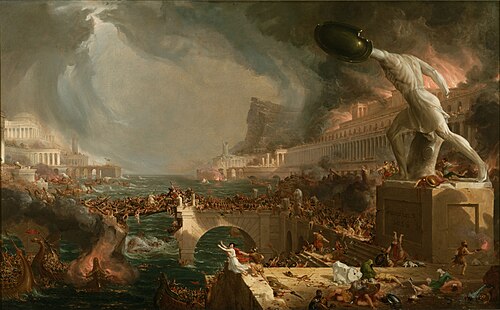
Civilization is also separation from an original wholeness and grace. The poor thing we call our “human nature” was not our first nature; it is a pathological condition. All the consolations and compensations and prosthetics of an ever more technicized and barren world do not make up for the emptiness.
John Zerzan
From its inception, civilization has been religious. Before the earliest civilizations, humans (and our recent and distant ancestors) had been tribal, in both the physical and psychological sense, for millions of years, part of the great evolutionary lineage that has produced all the apes, hominids, and other social primates. Around 300,000 years ago, anatomically modern humans emerged. But it wasn’t until about 60,000 years ago that we experienced a great leap forward, a sea change in behavioral and technological complexity that was likely triggered by some brain tweak that flipped us to a full linguistic mental architecture.
But still, even after that great leap, we lived as nomadic and seminomadic tribes for tens of thousands of years, hunting, gathering, and engaging in small-scale horticulture. However, it would not be accurate to see that long tribal interlude between 60,000 years ago and the birth of civilizations around 5000 years ago as a tranquil, utopian shangri-la. Rather, it was simply a long stretch of humans filling up the empty, then-accessible places on the planet. The human population 60,000 years ago was only around 10,000 to 50,000 people, due to a severe population bottleneck, a product of climate conditions and probably volcanic activity. But by the time the first civilizations started appearing in 4000 BCE or thereabouts, the global population had swelled to around five million.
Civilizations themselves, then, are not just the result of some startling new agricultural breakthrough. The fundamentals of horticulture had been known for thousands of years already. Rather, civilizations were the result of an explosively powerful new species filling up all the available ecological spaces, draining down resources, and finally bumping up roughly against other humans and other competing species. Everywhere that modern humans went exploring with their new mental architecture, mass extinctions of robust megafauna resulted, including all the competing hominid species that had previously co-existed with earlier humans.
As such, the story of civilization is one of power: the power of the newly evolved human brain to dominate both the ecological landscape and other human beings, in a newly crowded world. As this power unfolded, starting around 60,000 years ago, humans embarked on a massive terra-forming project, with a companion mega social-engineering system to animate it. As Ara Norenzayan described it in the book Big Gods, when human groups got bigger and bigger, new ideas were needed to hold the giant (in ancient terms) societies together. These new ideas were religions, mechanisms of social control that allowed supernatural forces to monitor and judge the behavior of thousands of anonymous strangers.
Since the face-to-face social cement of small tribes is impossible to replicate in huge civilizational formats, religion steps in to create a much larger, often universal tribe of co-believers, with the key element being a supreme supernatural entity of moral judgment, a projection of the people themselves onto a static, unchanging being or force. It is that supernatural monitor-judge that holds, or tries to hold, civilization together. As Norenzayan observes, “big communities need Big Gods.”
Now of course, we can immediately see the problem with Big Gods: Who gets to discern and decide what the gods want? The history of religious conflict, strife, conquest, and genocide is well-known; so well-known, in fact, that it is almost startling that anyone could still believe that their particular Big God is anything other than a useful construct of their specific tribe, a fiction used to dominate internal believers and to exterminate external infidels.
This is not to paint all religious people with the same brush. In general, “liberal” denominations and faiths do actually see different religious traditions as alternate paths to the same destination, flawed but universal human efforts to grasp the ineffability of the divine. And by contrast, “conservative” belief systems have a different view of their Big Gods. For these folks, only a tightly defined vision of the one true God can lead to truth and salvation, while other faiths are fatally flawed, leading (usually) to eternal damnation or final annihilation. In the words of the Sermon on the Mount: “Enter through the narrow gate. For wide is the gate and broad is the road that leads to destruction, and many enter through it. But small is the gate and narrow the road that leads to life, and only a few find it.”
So when conservative American Christians, like JD Vance and Lord Baldemort Stephen Miller, moan and wail about the decline of Western Civilization, wringing their hands over secularism, humanism, and moral relativism, they are essentially pushing the idea of a very small Big God, a supernatural monitor and judge who, despite being all-knowing, all-powerful, and (supposedly) all-loving, is really only concerned with people of my type, of my tribe, and to hell (literally) with everyone else.
But really, all these doctrinal specifics distract from the foundational function of religions: they are just one type of mechanism for holding civilizations together. And other competing systems have emerged as human societies have developed. Law, philosophy, science, art, technology, economics, government — all of these cultural creations have potential to hold huge groups of anonymous strangers together, just like religions. Generally speaking, then, religion is now just one menu item among many, all accomplishing the same thing, to one degree or another.
An uncomfortable question remains, however: Is civilization worth holding together? And if so, what version of it? Going back to that Big Gods problem: who gets to decide what version of civilization is worth pursuing?
The answer, or at least a good preliminary answer, can be found in Cicero’s axiom: “Freedom is participation in power.” Freedom is a universally acknowledged goal, but without power, it cannot exist. Power is the ability of individuals to control the contours of their lives, to shape the conditions of their bodies, their communities, and their livelihoods. If people don’t have these direct powers, then they are not free. And the brute fact is that civilizations have always been about centralizing power — via clerics, via despots and tyrants, via politicians and money lenders, via soldiers and strongmen, via bureaucrats. Nations and empires spin out gauzy, weepy, chest-filling patriotisms, undergirded by raw xenophobia, to create the myths of great civilizations, which are just cover stories to hide the removal of power from regular people. Big Communities need Big Gods and other Big Lies, all in service to hyper-unequal material conditions, social arrangements that may deliver endless bread and circuses, but which rarely provide true power and freedom for the masses.
In this light, civilization is not something that needs to be defended at all costs. Rather, our current consumer industrial format of civilization, which is both more powerful, more damaging, and yet more trivial than anything that has come before, must be scrapped, and that scrapping can only happen by rejecting all the Big Gods that hold it together.

