The difficulty lies, not in the new ideas, but in escaping from the old ones, which ramify, for those brought up as most of us have been, into every corner of our minds.
John Maynard Keynes
Sorry, faked you out with the C-word teaser. The word I have in mind is capitalism, that thing that we all swim in for our whole lives, but which we really don’t talk about all that much. Or to put it slightly differently, capitalism is either the most powerful socioeconomic force the world has ever known, or it’s a nebulous idea that really doesn’t mean too much anymore, as compared to the more modern terms we throw around, like economic growth, free markets, full employment, entrepreneurship, and consumerism.
While “capitalism” doesn’t get a lot of explicit mainstream attention any more, that is certainly not true of what is often cast as its opposite: socialism, or even communism. It’s telling that critics of socialism rarely come out and say, “We need to fight these evils in the name of capitalism!” Rather, the leftie demonic isms are juxtaposed against more wholesome entities, like freedom and democracy. The fact that the most capitalistic people in the US rarely describe themselves as such is a sign that the old C-word has become something to avoid in polite company, like your cousin-in-law’s stint in rehab or Mitch McConnell’s latest EEG.
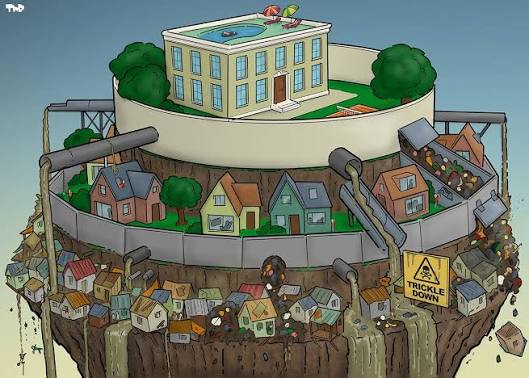
So why exactly has it become so uncomfortable to talk about capitalism? Why do we hide behind other, nicer terms that hopefully won’t rub too many people the wrong way? Why is it now woke to avoid the C-word? The answer is not complicated. It’s because capitalism, in its American format, has proven to be a ruthless and merciless set of algorithms, a crushing, driverless vehicle that churns through societies, extracting value wherever it can find it, and then selling it back to that same society to generate maximum and eternally-growing profit. As Matt Taibi described it, a “great vampire squid.” That seems about right.
Some other societies, noticeably the Scandinavian countries, most of Europe in general (for now), and even Japan and China, have been able to raise significant barriers to the worst aspects of capitalism, largely built on much older social and cultural customs and institutions, guardrails honed and earned via blood and sweat over centuries or even millennia.
But the United States has a much weaker set of guardrails (made of Nerf?), mostly due to our youth as a society, and because our founding was explicitly about making a buck, and not about those moldy old sociocultural safeguards present in other loser countries. Don’t buy the gauzy mythology that America was founded as a holy endeavor, a City on a Hill fulfilling its sacred mandate to win the New World for God. Nice story for the kiddies, but not remotely true. From its inception, the US has been a proto- and then a full-fledged capitalist project. Our ancestors came here for conquest and riches, and religion was just the skimpy fig leaf tucked in place to cover up the rapacious intent.
It’s rather strange that so many recoil in horror at this portrayal of America, while at the same time unabashedly extolling our nation as the best place in the world to get rich and “make it.” It reminds me of some great athletes, who are obviously much more physically talented than their opponents, and thus find it elementarily easy to defeat them time and again, but who then sheepishly give all the glory to God. It’s really a kind of sham, performative humility, akin to the Protestant Ethic described by the great Max Weber: the quasi-embarrassed wealthy classes explaining their good fortune as a humbling but unmistakable sign of God’s election.
This is the deep root of American hesitance to splash around the C-word. At some level, we’re embarrassed by the limitless greed and exploitation that defines capitalism and much of our national history, so we pretend that it is something completely different than that. Don’t call it “capitalism.” It’s the American Dream, or Manifest Destiny, or the Entrepreneurial Spirit, or bootstrap-ism, or a Horatio Alger rags-to-riches story. America is not about surrendering to the golden calf, slaughtering millions of indigenous people and enslaving and murdering millions of Africans, all in the name of God’s plan that white people should be rich. That’s not us, capitalism is not our idol. But if you must use the C-word, just keep it confined to the elitist pages of the WSJ and the time slots of Fox Business.
Although it may not seem so on the surface, Trumpism is actually a dire threat to capitalism proper. Sure, the plutocrats are getting their tax cuts, their LBOS and mergers, their slashed regulations, and their sweetheart no-bid contracts (anyone need a reflecting pool relined?). But that seeming pro-capitalist landscape is shaky, as Trump himself is much more interested in creating a full-speed-ahead kleptocracy, one where the government, in actual communist fashion, is buying up direct stakes in huge corporations, mostly to generate windfall profits for Trump and his cronies. He has a perverted kind of Midas Touch, turning everything around him into literal, tacky gold (-plate), or into digital and crypto profits for his own accounts and pockets. I mean, for God’s sake, he’s selling advanced access to his tweets ($100K per month), so that market players can openly embrace legalized insider trading, which of course comes at the expense of…. the rest of us.
Also, Trump has very little concern for the actual building blocks of capitalism: investment in infrastructure, workers, and consumer buying power. People have to have jobs and money to buy stuff, and that consumption is the lifeblood of the American economy as a whole. Household consumption is more than two-thirds of the US economy, and yet the labor share of GDP just dropped to its lowest level since 1929 (remember those roaring times?). Currently, the elites are driving the overall economy. The top 10% account for half of all consumer spending, while the rest of us have racked up record levels of household debt, surging medical bankruptcies, virtually no retirement savings, and the lowest labor-force participation rate in 50 years (pandemic excluded).
That is not sustainable, and that explains why Americans are now broke, angry, and desperately stressed out. But that is the capitalist system we have. It’s not the Trump system, or the wacko liberal system, or the Deep State system, or the shadowy globalist system. It’s capitalism, and in Trumpworld, if you’re not thriving in this system, tough shit. As Scrooge sagely noted, “If they would rather die, they had better do it, and decrease the surplus population.”
Many call this state of affairs “Late Stage Capitalism.” It’s a nice label, but its undoubted accuracy is also profoundly disorienting. Americans have been birthed, weaned, and then suckled by capitalism since our founding. What could possibly come AFTER this late stage capitalism?
Well, a rising answer on the left comes from the DSA, currently enjoying a surge of attention and electoral success. But predictably, this has given MAGA and other conservatives the opportunity to resurrect a Golden Oldie: a good ol’ fashioned Red Scare. The communist bogey man has returned, despite the reality that the DSA is as close to communism as JD Vance is to a good shave or a black best friend.
Trump himself is now energetically stirring up fear of the (probably trans) Commies, but still without using the dreaded C-word as the natural counterpoint to the nefarious pinkos. This results win a kind of weird limbo space, where the MAGA hordes are asked to fight the radical socialist libs in the name of, what, exactly? The Trump Arch and maybe a new edition of the Trump Bible with a Third Testament, “The Majesty and Miracles of Saint Donald”?
The truth is, capitalism’s time is indeed drawing to a close, one way or another. It is simply too powerful and destructive a force to endure much longer, as it destroys the ecological, economic, and social support systems that allowed it to emerge in the first place. In a sense, capitalism’s decline is a subset of the overall question about the human animal: Are we a sustainable species, or are we just too powerful for our own good, destined to kill ourselves by murdering our home?
So what lies ahead? As Gramsci famously noted, “The crisis consists precisely in the fact that the old is dying and the new cannot be born.”
Despite the breathless warnings of Trump and the present success of the DSA, socialism (let alone communism) is not really in the cards. Even the lite form of socialism represented by the DSA is still too enmeshed in obsolete questions around economic growth, full employment, revived unions, job retraining, etc.
A much more radical break with capitalism is needed, something that is paradoxically much more mundane at the everyday level, but revolutionary when implemented from below and then augmented simply but forcefully from above. Check out earlier posts for that this looks like.


One thought on “Why We Can’t Say the C-Word”